

YOUR HOSPITAL MAY BE LEGALLY REQUIRED TO FORGIVE YOUR BILL. THIS NONPROFIT HELPS YOU APPLY, FOR FREE.
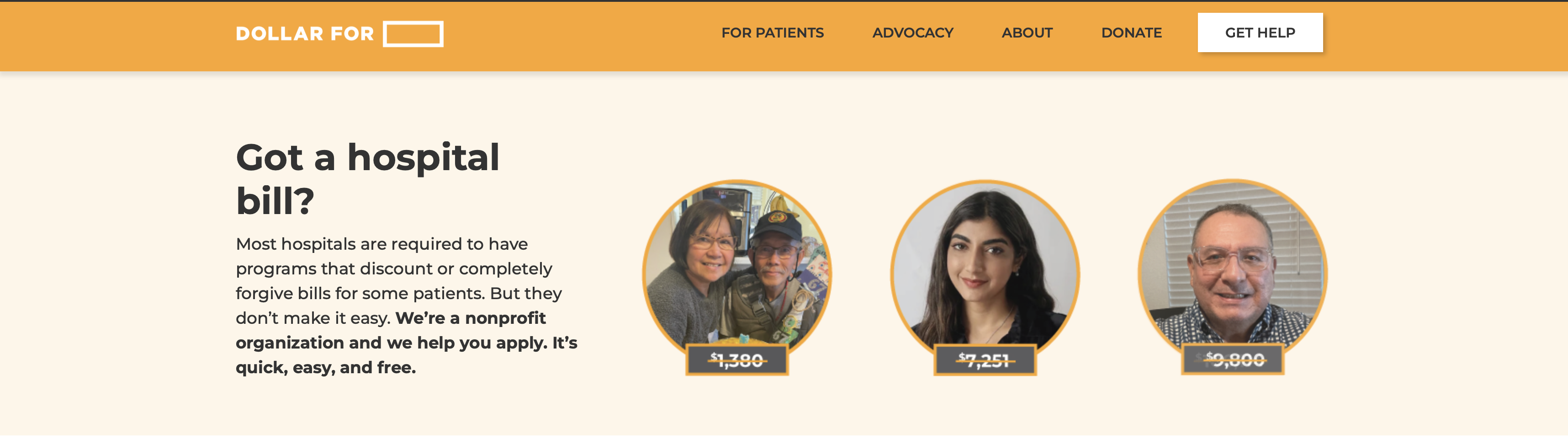
The hospital bill arrives. It's thousands of dollars, and most people do what they've always done: they panic, then they pay what they can, or put it on a credit card.
Almost nobody is told there's another option.
It's called charity care. Hospital financial assistance, sometimes called charity care, is a program that reduces or eliminates a bill based on your income. Nonprofit hospitals are required by law to offer it, and many for-profit hospitals offer help too. Dollar For's site says that, on average, a family of four earning less than $100,000 a year will qualify. Many people with jobs and insurance are surprised to learn they can qualify for at least some relief.
The catch is that hospitals don't exactly advertise it. Dollar For estimates that hospitals fail to distribute around $14 billion in financial assistance every year. Most eligible patients never apply, and many never learn the programs exist.
Here's how Dollar For helps. It's a nonprofit, and its service is free. You start with a short bilingual screener, about six questions, that tells you quickly whether your bill might qualify. If it does, Dollar For helps you prepare and submit the application to your hospital, follows up, and can submit additional documents or help prepare an appeal if the hospital pushes back. If you'd rather do it yourself, there's also an online Financial Assistance Handbook with the tips and tools. The organization says it shares your information only with your hospital.
The origin is a good one. Founder Jared Walker, based in Portland, Oregon, started out crowdfunding to help strangers pay medical bills. Then he discovered charity care: a law that already required hospitals to do much of what he was raising money for. He pivoted. A TikTok video he made in 2021 went viral, and patients across the country started asking for help.
The results are big. In a recent interview, Walker said Dollar For had submitted more than 41,000 applications for patients and eliminated more than $135 million in medical debt, and a news report this month put the total since 2021 at $170 million. Individual results ranged widely, from about $500 to as much as $430,000. In one example from that report, a patient's bill dropped by $2,100, leaving her with $200 to pay.
It's funded by donations and philanthropy. If you read our piece on Undue Medical Debt, which erases other people's old debt, think of this as the other half: help for the bill sitting on your own table right now.
Honest notes: it's for hospital bills in the U.S., and approval is up to each hospital, so there's no guarantee. Results vary a lot. And this is general information, not legal or financial advice.
Before you pay a hospital bill, run it through the screener first.
READY? HERE IT IS.
 oh, one more thing before you go — word on the street is you missed past Rubbernecks and you're falling behind. The archive.
If you click and buy something, we may earn a small cut. If it's boring, we don't feature it.

GET TOMORROW'S
JAW-DROPPER.
One site. Every day. Free. In your inbox. No garbage. Unsubscribe whenever.
MORE LIKE THIS
🐔 YOU THINK THIS IS THE ONLY ONE?
THERE ARE HIDDEN GEMS
YOU HAVEN'T SEEN YET.
A new jaw-dropper every day. Go dig through the archive — there's something in there that will wreck you.