

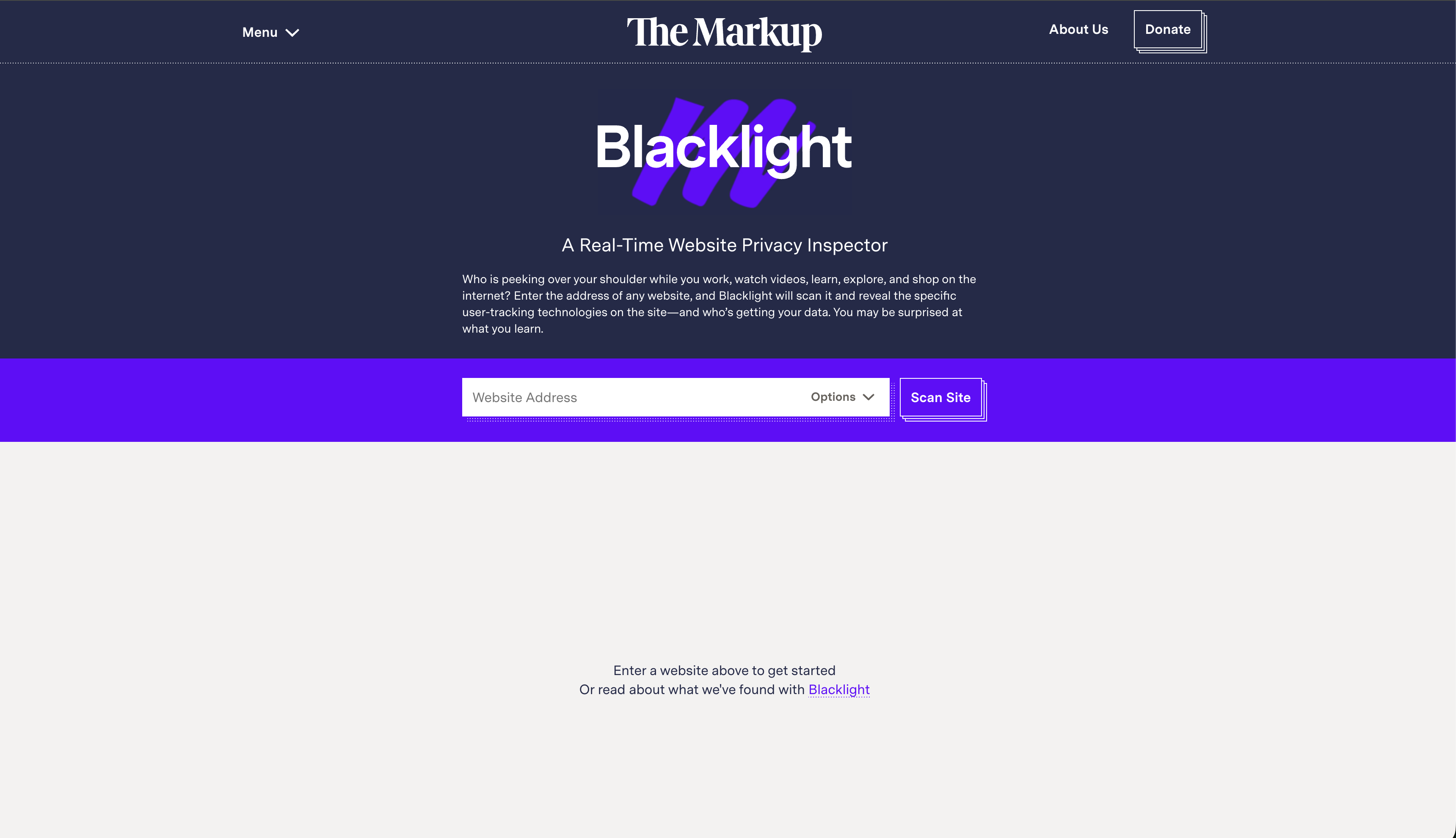
You can't see the trackers on a website. That's the entire design.
The page looks the same whether it's quietly passing your visit to advertising companies or not. Same layout, same buttons, same friendly welcome. Blacklight exists to make the invisible part visible.
Here's how it works. You enter the address of any website and press scan. Within 30 seconds to a minute, Blacklight reports the specific user-tracking technologies it found on the site, and who's on the receiving end of your data. You can choose to run the scan from Ohio, California, or Europe, and as a mobile or a desktop visitor.
What it looks for:
- Ad trackers: is the site sending data about its visitors to advertising companies? - Third-party cookies: cookies that follow you around the web. - Tracking that evades cookie blockers: ways a site can identify your browser even when you've blocked cookies. - Session-monitoring scripts: code that records how you move through and interact with a page. - Keystroke capturing: whether a site logs text you type *before* you hit submit. - Data sent to Facebook, TikTok, Twitter/X, and Google: checked separately, by name.
It comes from journalists, not a software company. Blacklight was built by The Markup, a newsroom that investigates how technology affects society and runs on reader donations. Surya Mattu led concept and development, and the tool launched in September 2020 alongside a reporting series on what these scans reveal. In October 2024, the team also released an open-source command-line version, Blacklight Query, for inspecting batches of websites at once.
Worth knowing: a scan is a snapshot of what the tool detected during one visit, not a verdict on anyone's intentions. Some of what turns up is ordinary website analytics, and some of it is more invasive. The point is that now you can see it and decide for yourself.
Try the sites you actually use: your bank, your pharmacy, your kid's school, the news site you read every morning. Then look at what came back.