

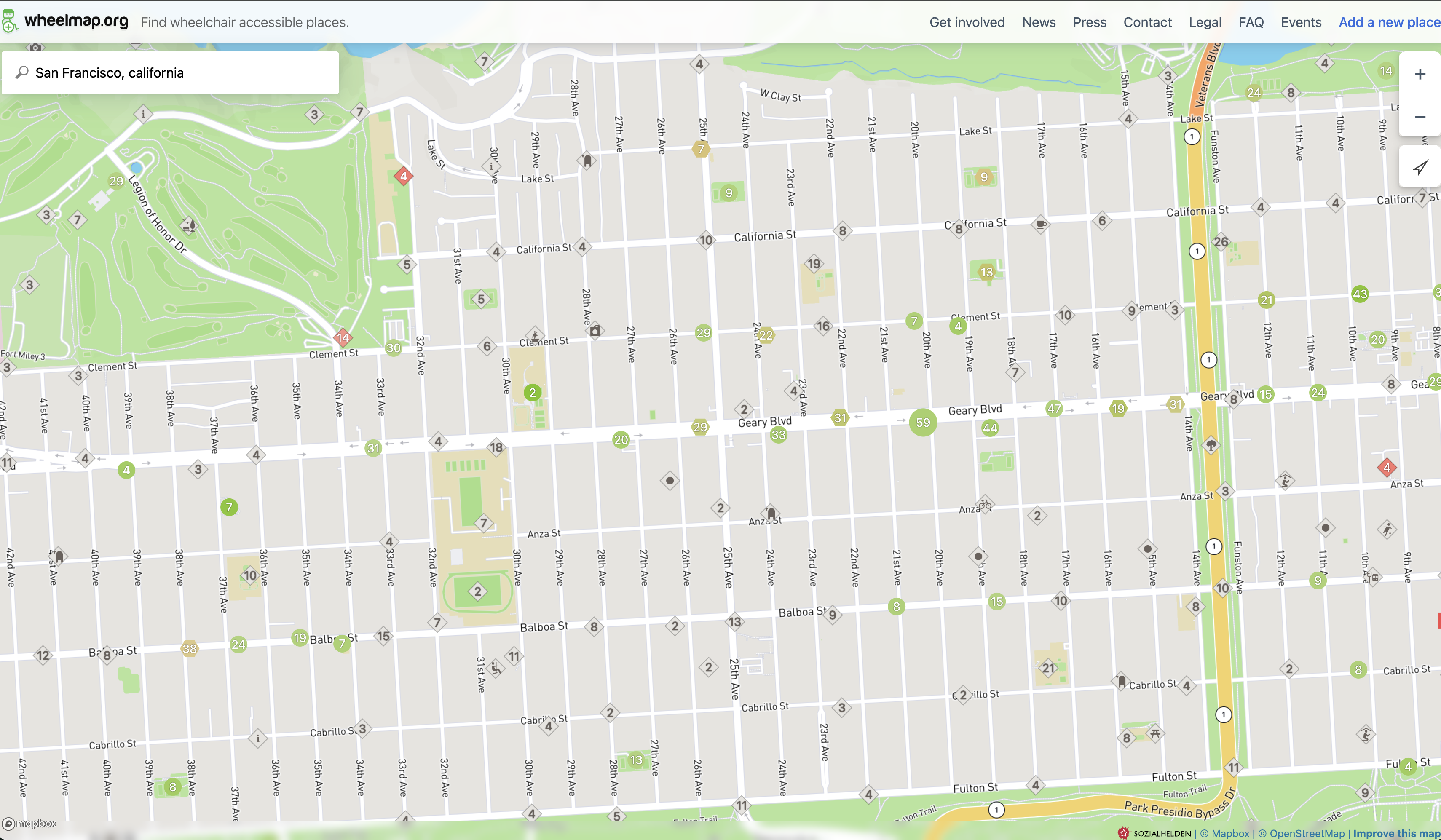
A café can look perfect online. Warm lighting, great pastries, a lovely terrace. And three steps at the front door.
For people who use a wheelchair or other mobility aid, that detail decides whether the trip is worth making. It's also the one detail restaurant photos almost never show. Wheelmap exists to fill that gap.
Here's how it works. Search for a place, or browse the map, and each spot carries a traffic-light rating:
- Green: step-free and fully accessible. - Orange: partially accessible. - Red: not accessible. - Grey: nobody has rated it yet.
Toilets are rated separately, so you can find places with an accessible restroom, and users can upload photos of entrances.
It was built by a Berlin nonprofit and is based on OpenStreetMap. Wheelmap is a project of Sozialhelden e.V., started in 2010 by a team around social entrepreneur Raúl Krauthausen. It sits on top of OpenStreetMap, the open, editable map of the world, which is why it works globally, and it covers 180 types of places, from cafés and libraries to swimming pools and doctor's offices. The site is available in more than 30 languages, free, on the web and as an app.
The scale comes from crowds. By its own count, Wheelmap holds information on more than 3 million public places, with 300+ new entries added every day. That's because anyone can add a place and rate it in a few clicks, and the ratings show up on the map within minutes. All of the collected data is also available as a free open dataset.
One honest note: a crowd-sourced map is only as good as the people who fill it in. Coverage varies by city and country, and a grey place means "unknown," not "inaccessible." For anything critical, it's worth calling ahead.
There's an easy way to make it better. Next time you're somewhere, rate it. A few taps for you could save someone else a wasted trip.
Check the door before you go.