

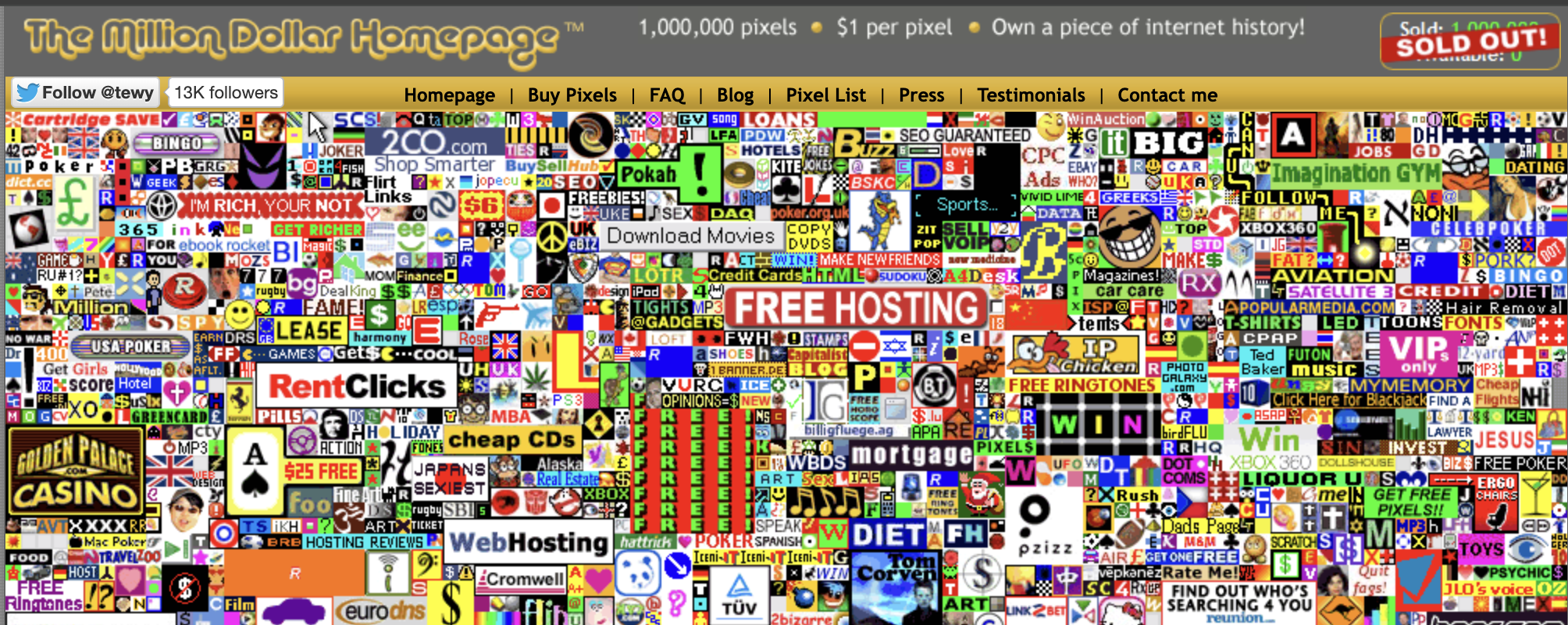
In August 2005, a 21-year-old student named Alex Tew sat in his bedroom in Wiltshire, England, wondering how to pay for university.
He had an idea. He would build a webpage — 1,000 pixels wide, 1,000 pixels tall — and sell every single pixel as advertising space, at $1 per pixel. Advertisers would buy blocks, upload a tiny image, and link it to their site. One million pixels. One million dollars. Simple.
His friends thought it was stupid. The internet thought it was stupid. Then it went viral.
He sold all one million pixels. The last 1,000 were auctioned on eBay and sold for $38,100. Total earnings: $1,037,100. Alex Tew paid for university, became briefly famous, and accidentally created one of the most-written-about internet moments of the 2000s.
The website still exists. Right now, in 2026, you can go to milliondollarhomepage.com and see it exactly as it looked the day he sold the last pixel — a chaotic, beautiful, completely insane mosaic of tiny advertisements from 2005. Casino sites. Tech companies. Random personal blogs. Things that no longer exist. Things that still do.
It's a time capsule. A museum. Proof that sometimes the dumbest idea is the right one.
Go look at it. Zoom in. Find something that surprises you.
There are a million of them.