

There are more rockets launching right now than at any point in human history.
Most people have no idea.
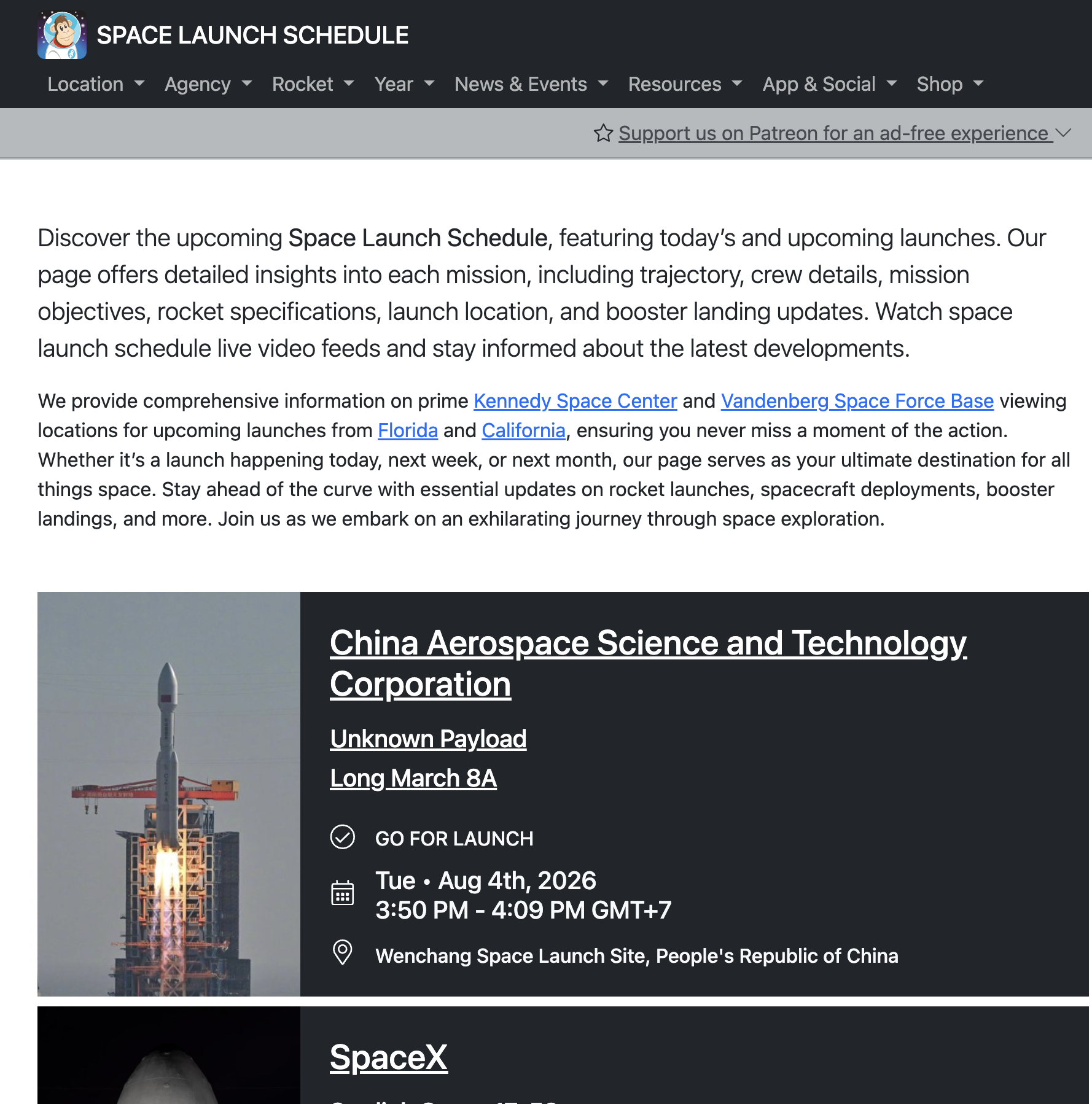
Space Launch Schedule tracks every orbital and suborbital launch attempt on earth — SpaceX Falcon 9s carrying Starlink satellites, NASA missions to the Moon, ESA launches from French Guiana, Chinese Long March rockets, Indian ISRO missions, private companies you've never heard of putting things into orbit for reasons that range from climate monitoring to space tourism to national security.
Each launch gets a full entry. The rocket. The payload — what's actually on it and where it's going. The launch site. The window — the exact time range when liftoff can happen. A live countdown. And when it's over, a result: success, failure, or scrubbed and rescheduled.
The pace is staggering once you start paying attention. SpaceX alone launches a Falcon 9 roughly every few days. There are weeks with five or six orbital launches across different countries and companies. The space industry in 2026 looks nothing like what most people picture when they think about rockets — it's not Apollo, it's a supply chain.
You can filter by rocket, by agency, by launch site. You can set notifications for specific launches. You can look back at the launch history and see how the cadence has accelerated year over year.
The next launch is probably sooner than you think. There might be one today.
Go check.