

Somewhere on your walk to work, a mulberry tree is dropping fruit onto the sidewalk. Nobody's picking it. It will rot, and the birds and the bottom of your shoe will get it.
Falling Fruit exists to turn that tree into a pin on a map.
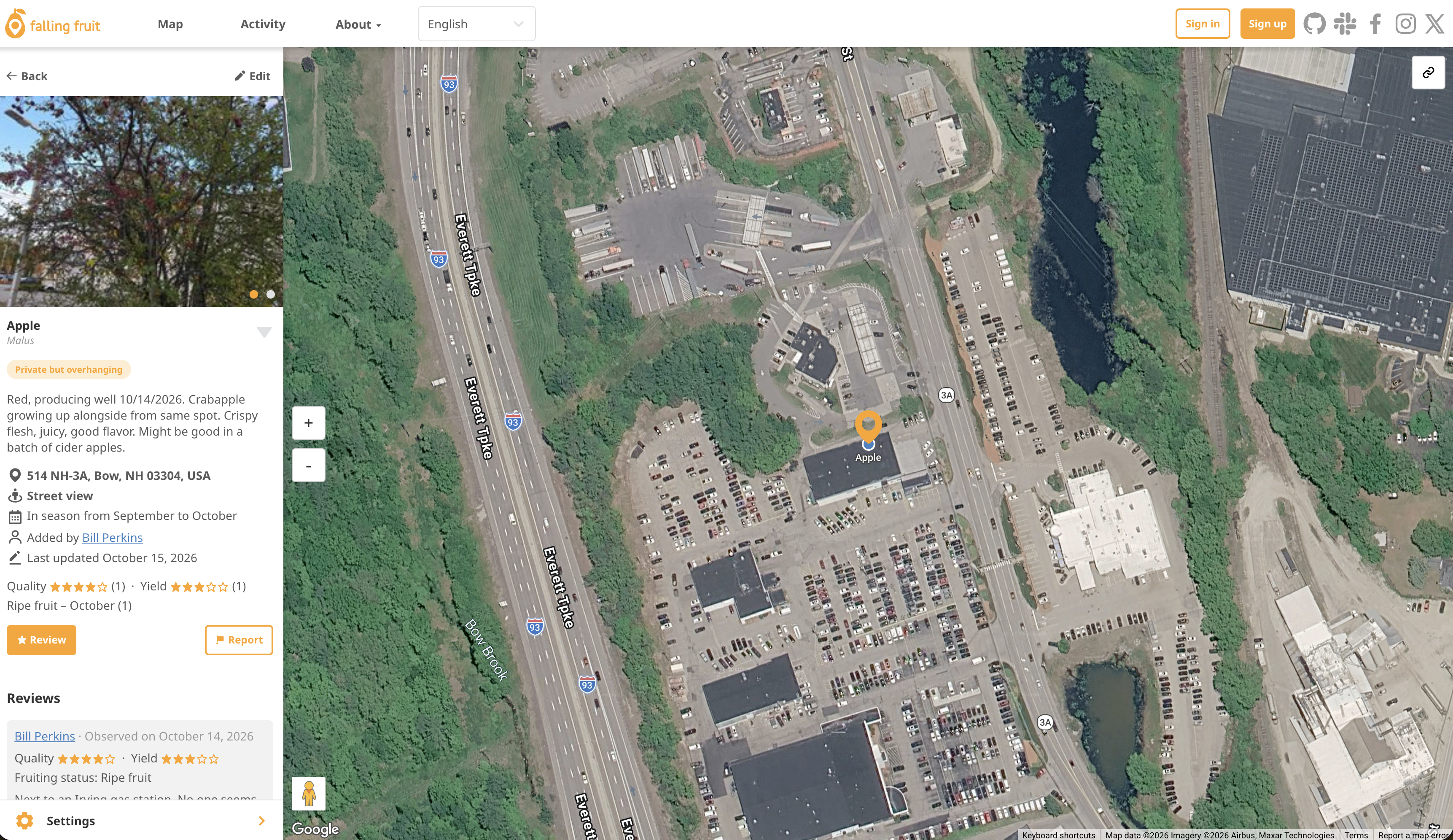
It's a collaborative map of the urban harvest. The site calls it a way to unite foragers, freegans, and foresters around the world, and the scale is big: nearly 2 million locations and more than 4,000 types of edible plants and mushrooms, including fruit trees, berries, nuts, and herbs. It also lists public water sources, beehives, and even dumpsters known for tossing out good food. Most spots are on public property, and some are on private land and are meant to be picked only with permission.
Anyone can add to it. The map works like a wiki. Users drop pins for the plants they find, and a lot of the original data came from city and university tree inventories, the kind of records municipalities keep for park management. One early press story described a user in Boston who added over 50,000 locations on her own.
The origin story is small and local. The map began in 2008 as Caleb Phillips' personal record of fruit trees around Boulder, Colorado. In 2013, he and Ethan Welty, a geographer and photographer he'd met through a food-rescue group, launched Falling Fruit as a global map. One photo from their early days shows Welty and a friend standing among 500 pounds of apples they'd picked from neighborhood trees in a couple of hours.
The big idea is bigger than free fruit. Welty has described the project as a form of activism: a way to get people to see their cities as places that can feed them, and to push for "food forests," public spaces planted with edible trees as naturally as ordinary street trees. Billings, Montana, for example, has planted more than 120 fruit trees in its parks since 2018.
Falling Fruit is a nonprofit with mostly volunteer staff, and it relies on donations. The code and the data are open.
A few honest notes before you go out with a bucket:
- It's crowd-sourced. The founders have said they can't verify every spot, so a pin isn't a guarantee that a tree is public or that fruit is ripe. - Check the land. Some listed spots may be private or off-limits, so look for signs, ask permission, and follow local rules. - Only eat what you can identify with certainty. This matters most with mushrooms.
Open it, zoom in on your own street, and see what's been growing there all along.