

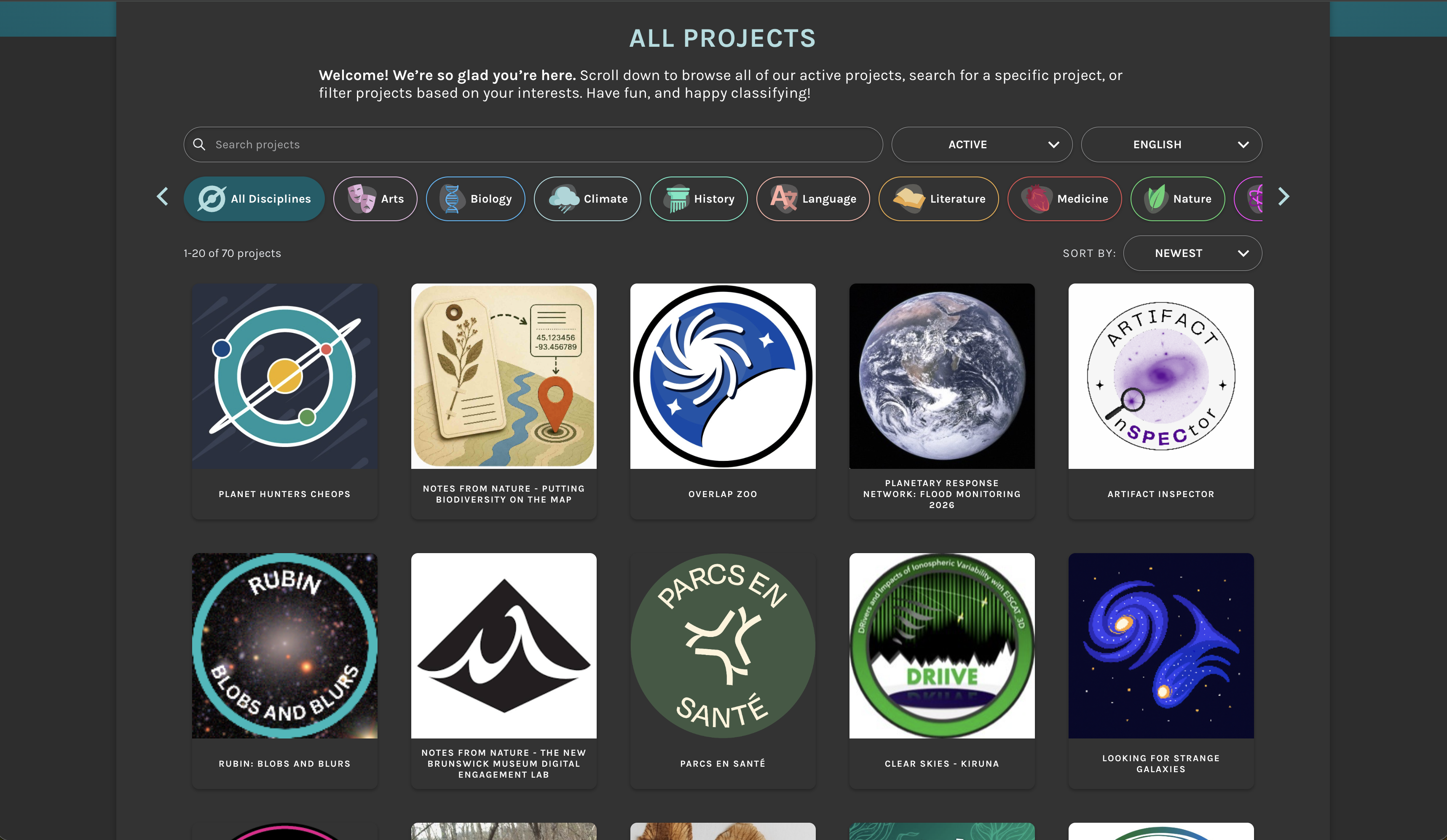
Modern science has a problem most of us would love to have: too much data. Telescopes, trail cameras, and archives produce far more images and records than any research team can go through alone. Computers help, but for plenty of jobs, human eyes are still better at spotting patterns.
Zooniverse is built on that fact.
It started with galaxies. In July 2007, an Oxford astronomer named Chris Lintott launched Galaxy Zoo, asking the public to look at telescope photos and sort galaxies into spirals, ellipticals, and mergers. The response was enormous. A conference paper reported more than 70,000 classifications an hour within the first 24 hours, and the original project went on to collect classifications from more than 180,000 volunteers on nearly one million galaxies, leading to more than forty scientific papers.
That success became a platform. Zooniverse is now run by a collaboration that includes the Adler Planetarium, the University of Oxford, and the University of Minnesota, and it calls itself the world's largest and most popular platform for people-powered research.
Here's what you can do. Projects span the arts, biology, climate, history, language, literature, medicine, nature, physics, space, and the social sciences. You might search telescope data for planets around other stars, look through wildlife photos and name the animals you see, or transcribe handwritten historical documents. One transcription project reported that its volunteers matched the accuracy of experienced specialists.
You don't need any background. The tasks come with tutorials, and many are simple enough for elementary and middle school students and families. The Snapshot Safari projects, which involve identifying animals in photos, are especially good for young children. Each image is looked at by many different people, and the agreement between them is how the results are checked. That's why one person's clicks matter.
And it's a real community. Each project has a discussion board where volunteers talk directly with researchers, and some of the most interesting discoveries have come out of those conversations. Zooniverse projects have produced hundreds of peer-reviewed publications that credit their volunteers, and dozens of volunteers have been co-authors.
Researchers can also build their own project using the platform's project builder.
A few honest notes: the scale figures I found are a few years old (over 120 projects and more than two million registered volunteers as of 2020), so the real numbers are likely higher. Projects also finish when researchers have enough classifications, so pick one that's marked active.
Pick a subject you're curious about, spend ten minutes, and your click becomes part of a study.