

A LIVE MAP OF WHAT THE WORLD'S BACKYARDS SOUND LIKE RIGHT NOW. CLICK A SPOT, HEAR THE BIRDS.
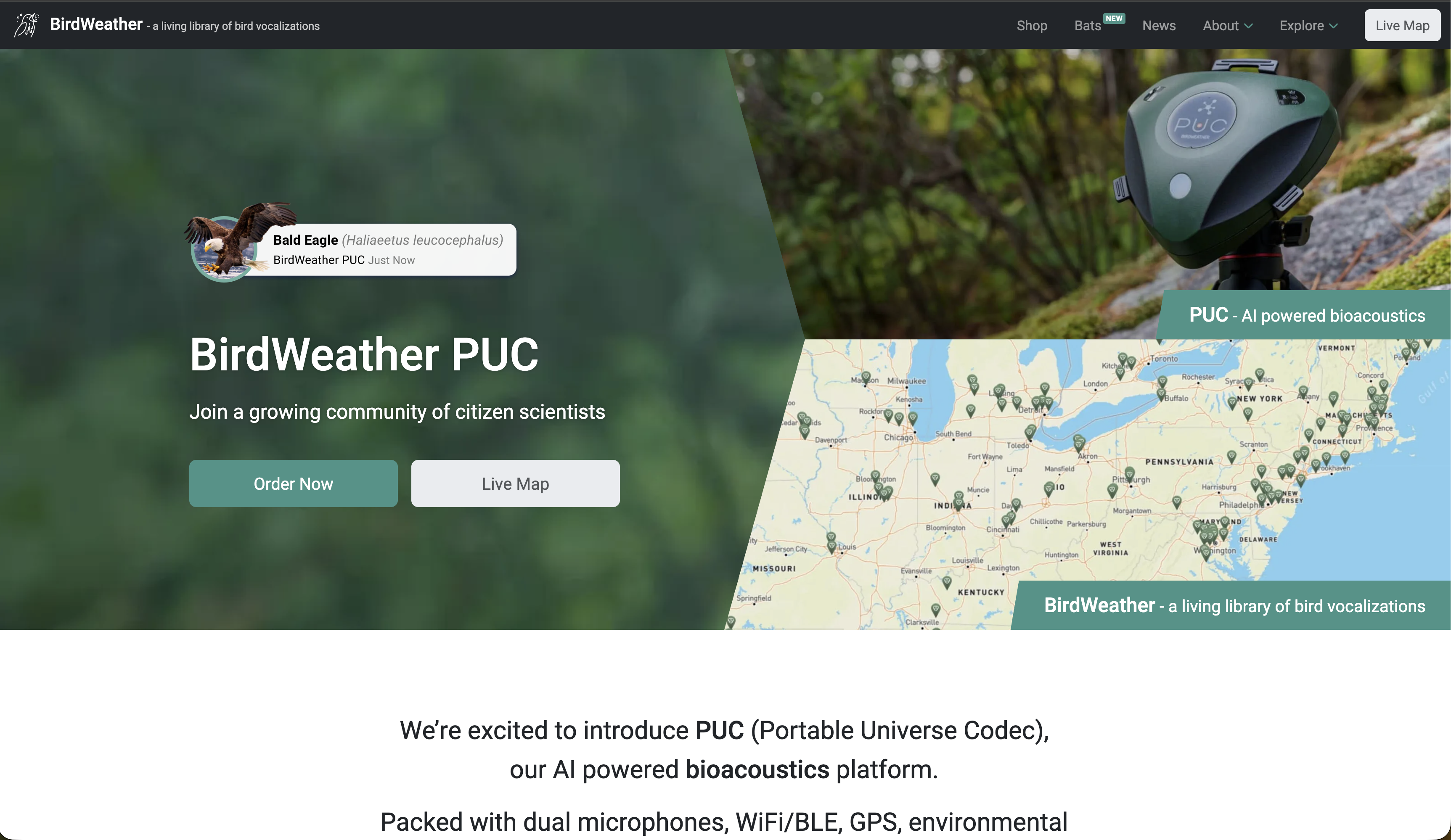
Right now, in the trees outside your window, there are probably birds you've never noticed. You'll hear them without seeing them, and by the time you reach for your phone, they've gone quiet.
BirdWeather doesn't blink, and it never goes quiet.
Here's the idea. BirdWeather describes itself as a living library of bird vocalizations built by citizen scientists worldwide. People set up small listening stations, and every sound the stations pick up is sent to the cloud, where an AI called BirdNET identifies the species. BirdNET is a joint project of the Cornell Lab of Ornithology and Chemnitz University of Technology, and BirdWeather says it covers over 6,000 bird species. It also flags non-bird sounds like coyotes, dogs, frogs, and insects, and the site says it automatically removes any recording that contains human voices.
The free part is the best part. You don't need a device to explore. The live map shows listening stations around the world, the home page lists recent top detections you can click to play, and there are free mobile apps for iOS and Android for listening to soundscapes. Open it, pick a place, and hear what a stranger's backyard sounds like at this moment.
If you want to build your own station, the main device is the BirdWeather PUC, a palm-sized, weatherproof listener with dual microphones, GPS, and environmental sensors that runs on a one-button setup and connects to Wi-Fi. The site stresses there's no subscription, and the data is yours to download. There's also a Bat Edition that listens at ultrasonic frequencies, so you get "birds by day, bats by night." For tinkerers, BirdNET-PI is a do-it-yourself way to join, built on a Raspberry Pi.
The data is open and it's being used. BirdWeather offers public APIs and a data explorer for researchers. Its press page highlights coverage of an August 2025 study of millions of audio recordings, which found that artificial light makes birds wake earlier and go to bed later. The Guardian's headline said urban birds settle down for sleep about 50 minutes later than their rural counterparts.
Who's behind it: Scribe Labs, which describes itself as a small team of technologists, led by founder and CEO Tim Clark. It's a company, not a charity, and the PUC raised more than $130,000 on Kickstarter in 2023 against a $50,000 goal.
Honest notes: the PUC isn't cheap (reviews and deal listings put it around $250 at various times, so check the shop for today's price). It records audio only, with no camera. AI identifications aren't perfect. And if you just want to identify birds, free alternatives like Cornell's Merlin app exist, which is exactly the comparison some reviewers make.
You can spend an afternoon on the map and not spend a dollar. Click somewhere you've never been and listen.
READY? HERE IT IS.
 oh, one more thing before you go — word on the street is you missed past Rubbernecks and you're falling behind. The archive.
If you click and buy something, we may earn a small cut. If it's boring, we don't feature it.

GET TOMORROW'S
JAW-DROPPER.
One site. Every day. Free. In your inbox. No garbage. Unsubscribe whenever.
MORE LIKE THIS
🐔 YOU THINK THIS IS THE ONLY ONE?
THERE ARE HIDDEN GEMS
YOU HAVEN'T SEEN YET.
A new jaw-dropper every day. Go dig through the archive — there's something in there that will wreck you.