

POINT YOUR PHONE AT ANYTHING ALIVE. A GLOBAL COMMUNITY TELLS YOU WHAT IT IS. SCIENTISTS USE IT.
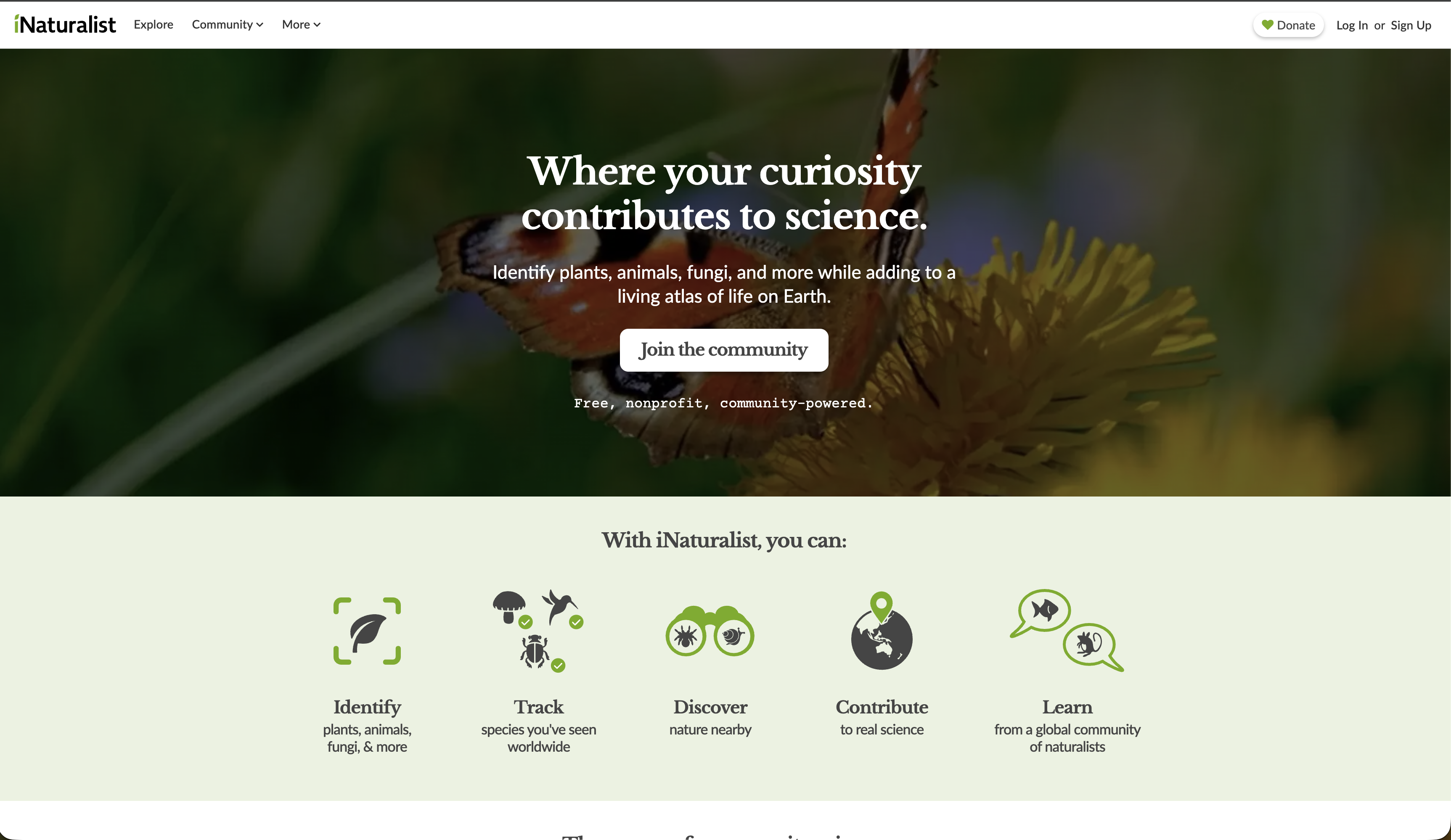
Everyone has stood over a strange mushroom, a mystery bug, or an unfamiliar flower and wondered, "What is that?" Most of the time, we take a photo, forget about it, and never find out.
iNaturalist turns that moment into something useful.
Here's how it works, in three steps. First, you observe: open the app and photograph any wild plant, animal, fungus, or other organism, in your neighborhood or anywhere in the world. Second, you identify: the app suggests an identification instantly, and a global community of naturalists confirms or refines it. Third, you contribute: when the community agrees on an identification, the observation becomes "research grade" and enters the global scientific record as open data.
The scale is enormous. The site's own stats say more than 300 million observations, over 550,000 species documented across the globe, 7,000+ scientific papers citing iNaturalist data, and 500+ species discovered or rediscovered by community scientists.
The stories are the best part. A tourist in New Zealand spotted a Frosted Phoenix moth by accident, a species that hadn't been seen in decades and was once thought extinct. A woman walking in her neighborhood in Australia found a mantis that turned out to be new to science, and it was named Inimia nat, abbreviated "I. nat." In California, a group of local volunteers who met through iNaturalist worked together to protect migrating newts crossing a busy road.
You don't need to know anything. The site says you don't need to know what you're looking at, and you can upload older photos as long as you know roughly when and where they were taken. The website works well on a desktop, the app is best for identifying things on the go, and there are dozens of language options. For children under 13, there's a separate app called Seek, which earns badges and joins challenges to observe species.
It's free and nonprofit. iNaturalist describes itself as a nonprofit organization that supports science and conservation, funded by donations. Its software is open source, and it calls its community "the nicest place online," a phrase it takes from a local news headline.
Two honest notes: an identification is a suggestion until the community agrees on it, and everything you post is public, open data. So think about what you share, especially exact locations of sensitive spots.
Take one photo of something you can't name. That's all it takes to start.
READY? HERE IT IS.
 oh, one more thing before you go — word on the street is you missed past Rubbernecks and you're falling behind. The archive.
If you click and buy something, we may earn a small cut. If it's boring, we don't feature it.

GET TOMORROW'S
JAW-DROPPER.
One site. Every day. Free. In your inbox. No garbage. Unsubscribe whenever.
MORE LIKE THIS
🐔 YOU THINK THIS IS THE ONLY ONE?
THERE ARE HIDDEN GEMS
YOU HAVEN'T SEEN YET.
A new jaw-dropper every day. Go dig through the archive — there's something in there that will wreck you.